Thursday, August 21, 2008

Watchmen, We Love You All


Being a bit of a nerd, I've never really grown out of comics. From the the age of 8 until I went off to art college I was an avid reader of 2000AD - and It was very influential in my choice of career. As a kid I would copy the comics' illustrators like Brian Bolland, Mike McMahon and Carlos Ezquerra (along with McMahon was famous for drawing the iconic Judge Dredd, below, with enormous feet - "They are not big feet - he just wears big boots"). I was always drawing, so it was natural that I would follow an 'arty' career. I knew early on that I'd never make it as an illustrator, and I ended up designing books and magazines.


One of the early writers for 2000AD was Alan Moore, for which he wrote (amongst many other wonderful things) The Ballad Of Halo Jones. He's written some the the best stories there have ever been - It's an overused phrase, but Moore really is an eccentric, beardy genius (he worships a Roman snake deity called Glycon). Arguably, his best work has been outside of 2000AD - including From Hell, The League Of Extraordinary Gentlemen, V for Vendetta and of course The Watchmen. Originally published as a comic in 12 parts, The Watchmen is set in 1985, in an alternate United States with the world on the brink of nuclear war. The main characters are costumed adventurers. They are all very human (except for one). It's like nothing I've read before or since. Time magazine has named it as one of the best 100 novels of all time. Next year it's going to be made into a film. The movie adaptions of Moore's work ranges from the mediocre (From Hell) to the downright embarassing (The League Of Extraordinary Gentlemen - which made me want to cry, it was so bad). However, this trailer for Watchmen looks really promising. It's going to be directed by Zack Snyder who made 300. Surely it must be impossible to make a bad film out of Moore's masterpiece, which is like 'reading' a film anyway.

I'd like to point out that the bloke on the end of the trailer isn't me.

Wednesday, August 13, 2008

China In Your Hands


It's the Olympic games, and the whole world is pointing their cameras at China. I've been lucky enough to visit the country twice. The first time was a brief skip over the border to Guangzhou while visiting pre-handover Hong Kong. The second time was a much bigger trip - four weeks. We kicked off in Beijing and ended up Hong Kong. We got to know China's trains* pretty well, travelling by hard sleeper. Each carriage had its own attendant who diligently arranged the curtains and pushed loose luggage straps back into the overhead racks. We found the Chinese to be shy but curious. We weren't exactly pioneers but it's clear many people there haven't met Westerners. Hard sleepers are split into bays, open to the corridor with six bunks in each bay, and we got a constant stream of visitors, mostly who just came to look. In cities we got used to 'staring squads' - one bloke even going into a cafe to bring out his mates to see. Many times I was asked to join a family photograph - as I type this there's probably a chap at Long March People's Tractor Facility chuckling over the picture he took of me in Beijing on his pilgrimage to Mao's tomb. We saw medieval poverty and expanding modern cities that we'd never even heard of. Hangzhou has a population of almost 2 million, and (I was told) about 150 motorcycle factories. It was like being in Britain at the height of our industrial power. Make no mistake, the future belongs to China. I lost count of the miles we travelled on the Chinese rail network - thousands. We weren't delayed for a minute. When we got back to Heathrow, the tubes were knackered, the Heathrow Express was down and we couldn't get a bus. We ended up spending 70 quid in a taxi home. Maybe we should get the Chinese to organise London 2012.

* From Shanghai to Guillin we flew. Air China's inflight meal was bread and water.

Monday, August 4, 2008

Safe Hands

Sitting in Holborn like a spinster aunt's display cabinet is the Princess Louise, every visitor's idea of what a London pub should look like. The interior dates from 1891, and It's magnificent - a riot of etched glass, mahogany, mirrors, mouldings, tiles and brass. Some of the fittings are rumoured to be by Morris and Co. It's a bit like having a pint in the Victoria and Albert Museum. Even the gent's facilities are original and seperately listed. The pub is part of the Samuel Smith brewery's London estate. This mysterious company is Yorkshire's oldest brewer, never gives interviews and doesn't even have a website. They have a track record of looking after their properties - last year I was walking past another of their Holborn pubs, the Cittie Of Yorke, and two old chaps were applying gold leaf to the hanging sign. Everything they sell is own-brand, even the spirits. Their prices are laughably low - two pints of Old Brewery Bitter for less than four quid. It is believed there's no piped music so that the money saved from broadcast licenses is passed on to the customer. Last year, with no fanfare or even a press release Smith's decided to close the Louise for a six-month restoration - and what a great job they've done. The most obvious change is that partitions have been replaced - they were ripped out in the seventies as part of the mania for one-room pubs. Not everyone likes Sam Smith's beer, but I do. It tastes all the better knowing that the company is run by people who actually seem to give a damn about pub heritage.


*EDIT*: I was in the Cittie Of Yorke on Sunday - and their hanging sign is polished (burnished?) copper. So whatever those two old chaps were applying to it, it certainly wasn't gold leaf. But whatever they were doing was certainly very intricate, labour intensive and probably only learnt from a 15-year apprenticeship. It would surely given a bean-counter from a macrobrewery heartburn.

Saturday, August 2, 2008

A Yorkshire Welcome


I pulled a 13-hour shift yesterday, scooting home at 11.30pm amongst Britain's worst drivers. When I got in, Mrs TIW (herself born in that London) surprised me with this arrangement of Yorkshire produce. Just brilliant.

Friday, August 1, 2008

It's a Yorkshire Thing


Today is the 1st of August - Yorkshire Day. It was first celebrated in 1975 when the Yorkshire Ridings Society adopted the day to protest about the historic borders of the county being faffed about with. The significance of the date has its roots in 1759, when after the battle of Minden, Yorkshire troops wore white roses as a tribute to fallen comrades. It's also the anniversary of the Slave Abolition Act of 1834, which Yorkshireman William Wilberforce helped come to pass. Tykes don't need an excuse to celebrate where they are from, so It's only in the last ten years that the day has really entered the consciousness of the county's 5 million inhabitants. There seem to be more events every year - quite a lot of them involving pork pies (bought from a butcher, not a baker), beer and the Mayor of Wetwang. The border changes still rankle - Saddleworth, for example, now sits just inside Lancashire but always has a defiant white rose sticker on the town's sign. When Oldham council remove it, it's back again the next day. In the old East Riding things were worse - the Humberside signs were regularly uprooted by JCBs or even blown up with explosives - events celebrated by local poets and folk singers.

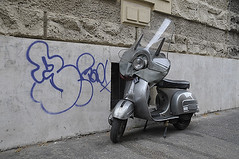
I'm Yorkshire to my marrow, and proud of it. Today I stuck a small flag on the back of my Vespa for the ride in. I'm working tonight so I'll postpone my celebrations until sunday when I'll be supping Samuel Smith's Old Brewery Bitter with my Spanish mate Gonzalo - so, happy 'Jorkshire' day.

Wednesday, July 30, 2008

Small Wonder

Rome
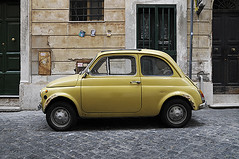
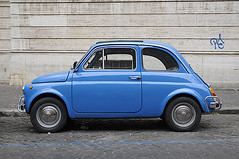
Often affectionately known as the Bambino, the Fiat 500 was for many Italian families their first proper car, replacing the Vespa (or Lambretta for the families who liked to walk) as their primary transport. Craig from Scooterworks imports them into the UK. I'd love one, but with my anglo-saxon-nordic frame I'd be driving with my knees up by my ears. Despite not being made since 1975, there are still a surprising number of Cinquecenti gurgling about Rome. No matter what condition they are in (and often they are in better nick than nearby modern cars) they are so comically photogenic I half suspect that the Italian tourist board leaves them around the city to enchant visitors.

Italy
Italy

Tuesday, July 29, 2008

Lazy blogging


OK - I put my hands up, this is a bit slack. But It could hardly be a Vespa-biased blog without a clip from Roman Holiday, could it? The bit where the scooter runs away with Audrey Hepburn must have happened to almost all Vespisti on their first attempt at riding - myself included. On every visit to Rome I've promised myself that I'd hire a scooter, just to ride round the Vittorio Emanuele memorial but the traffic looks so terrifying that I always chicken out. Ending up under a Fiat 126 isn't much fun if you're solo, let alone with a passenger. It's doubtful we'd look as cool as these two anyway, despite Gregory Peck's random pointing. Watch out for the police in their WW2 surplus jeep. I wonder where that 1953 faro basso is now?

Friday, July 18, 2008

Ciao, Vespa

Italy
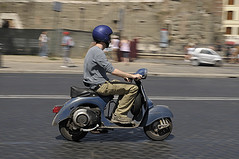
Geared Vespas are becoming a rare sight in Rome. With the exception of this chap on a Sprint Veloce zooming down the Via dei Fori Imperiali, I didn't see more than than a handful of classics. The Roman's favourite transport is the motorini, the ubiquitous automatic scooter parked on every square inch of pavement and in every nook and cranny of the Eternal City's alleyways. The canny Italians have long been selling off their geared scooters to British and American dealers, and since the demise of the P-range last year prices have shot up. It's perhaps significant that the scooter that I saw with the heaviest lock and chain was this Rally parked up near St Peter's Square.

Italy

Monday, July 14, 2008

Film's not dead

Italy

We were in Rome for the weekend, a city as beautiful as Paris but without the air of pristine-boulevard smugness. The Eternal City is a bit grimy, and all the better for it. It's a city for living in - care of the fabric of the place comes second to the serious business of being Italian. And Romans love being Italian. That bit of graffiti removal can wait until after dinner.

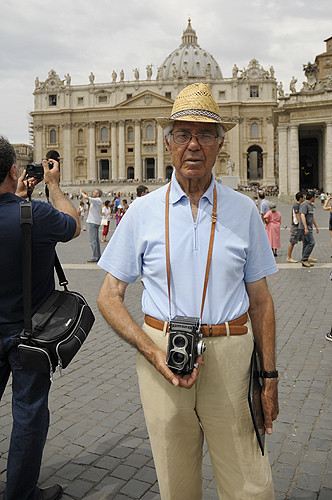
In St Peter's square I spotted this stylish gent with a Rolleiflex TLR. I assumed he was a visitor, but then I noticed there were four elderly men equipped with these vintage cameras - they were commercial photographers taking pictures of tourists on film for 6 euros a throw. This guy was very proud of his Rollei - "Made in Germany!" - and seemed a bit baffled by my DSLR - it's just conceivable that the so-called digital revolution has completely passed him by. I hope so. Film use today often has a post-modern element to it, so It's good to know that there are four old blokes in Italy who still make an irony-free living shooting tourists on antique cameras.

Tuesday, July 8, 2008

On the Waterfront

During my lunch break the other day I noticed this faded relic of a London of busy wharves and lightermen. It's painted onto the stonework of the northern end of London Bridge. There still are 'offices above', although the nearest boat these days is the London Regalia floating boozer. The sign's a long way above eye level - perhaps it was for the benefit of a crane driver? The modern London bridge was opened in 1973, although each end dates from the previous bridge that opened in 1831 - I suspect this nice bit of signwriting dates from the interwar period. It's not hard to imagine a desk-bound, pen-scratching clerk wincing every time a docker shouted to his mate or dropped a barrel, though I can't believe that this sign had the desired effect.

I've lost count of the times a tourist has asked me for directions to London bridge - I always ask them if they mean Tower Bridge (miming the road lifting with my arms) - and they always do.

Monday, July 7, 2008

Plastic, man


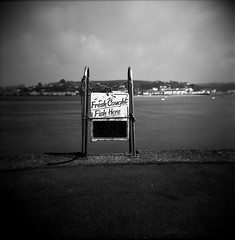
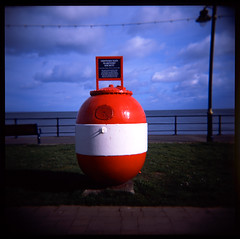
Dusty Seven's images of Briggs were taken on a Holga . This toy-like, medium format camera was originally produced in China so that even the very poorest members of society could take photographs. Gradually, it came to the notice of western photographers. They were charmed by the idiosyncratic images produced by the Holga's plastic lens and inherent light leaks. I first encountered these cameras when living in Munich about 10 years ago. I bought one from Foto Schaja on Sendlinger Strasse - perhaps the only photography shop where some of the staff wear lederhosen. From then on, the Holga never left my rucksack as I tramped around the Bavarian capital.

Recently, I bought a glass lensed Holga. What a difference 10 years of quality control make. On the old version, it was neccesary to shove a folded up bit of cardboard under the takeup spool to tension the film. The new holga has foam tensioners. It's not exactly Leica quality, but it works.

Devon

Yorkshire

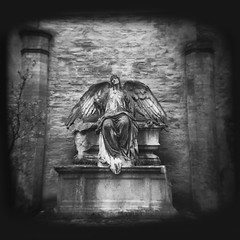
This picture of a bomb damaged tomb was taken in 1998 in Munich's Sudfriedhof cemetery . The soft, dreamy quality was produced by the plastic lens. I can't imagine getting the same effect with a digital camera without a lot of post-processing. That's the brilliant thing about the Holga - you become an art photographer without really trying.

Germany

Friday, July 4, 2008

Get A Haircut


Dusty Sevens has come up with the goods again with this set of superb images of Briggs Barbers, Piccadilly. I don't have much hair, but I love going to the barbers. If it's got Belmont chairs, styptic pencils, Duralon combs ("Unbreakable in Normal Use") and Cossack hairspray, i'm happy. Lots of gent's salons got tacky makeovers in the 80s, but Briggs is untouched. It's owned by a Cypriot called Phillip, who's been there since 1949. Apparently, he's not as scary as he looks.

More of Dusty Seven's pictures here

Monday, June 23, 2008

Chips with pesto, please


Unlike me and the Village Garage, some people had the foresight to record what has gone, before it went. Paul Kelly made a trio of short films about London's cafés called Today's Special - this one is about the New Piccadilly, but the other two which can be found here cover such lost gems as the Copper Grill which was behind Liverpool Street Station, and the beautifully moribund Tea Rooms on Museum Street. The Tea Rooms was always just out of my way so I never got a chance to visit, although I did drop by to take this photo last year. All the cafes featured in Today's Special are gone - but the shell of the Tea Rooms hangs on like a murder victim propped up in a corner.

Tuesday, June 17, 2008

Where Service Mattered


It's a bad time for the character of London's soul. From Dusty 7s comes the shocking news that the Village Garage in Bloomsbury is closed and boarded up. This great art deco survivor had been cheerfully pumping petrol from a corner of Store Street - itself lined with independent shops and cafés - since 1926, and was thought to be the oldest petrol station in London. It looked like an enlarged version of something found in a model village. I only filled up there once. Remarkably, It wasn't self service - and I can't be entirely sure that the chap who came out of the tiny office wasn't in a brown store coat and smoking a pipe. According to The Londonist The congestion charge has caused a drop in business, and the lease expired on June 6th. Presumably we can look forward to more flats on the site. Ho hum.

(picture from Mike Smith - a lesson learned - I never took a picture while I had a the chance)

Tuesday, June 10, 2008

Another Soho Tragedy

gone gone gone

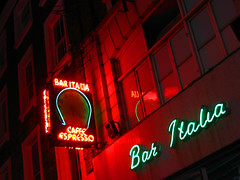
From flickrite Sunshine Indoors comes the dread news that coffee merchant Angelucci has moved out of Frith Street after 79 years. They're now going to be trading from East Finchley. I never got around to visiting their dark little shop with its original sans serif signage and 50s cash register. Whenever I tried, it was always closed, but I'm very familiar with their coffee - they have been supplying nearby stalwart Bar Italia with their Mokital blend since 1949.

London

London

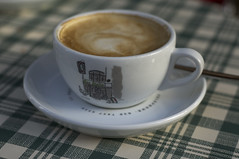
At least the venerable Algerian Coffee Stores is still there on Old Compton Street. A few weeks ago, my wife and I picked up a bag of their Bolivian organic blend. The smiley chap behind the counter suggested this to us after we told him of my inability to wake up properly. It's as black as coal dust. I tried a shot the next day, and immediately felt like I'd been wired into the national grid. I didn't sleep properly for three days.

Friday, June 6, 2008

Blimey, That's Good


.
From Argentinian street artist Blu comes this astonishing short film. It's called MUTO - and to describe it merely as 'animated graffiti' is a gross insult.

More good stuff here

Thursday, June 5, 2008

Hallucinating Light

France

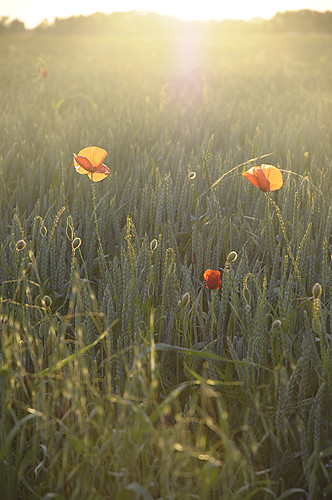
There is a very special quality to the light in the area round Archingeay, a hamlet in the Charente-Maritime bit of France we visited last week. We were staying with my wife's parents in their part-modernised farmhouse, lost in a million hectares of fields. It felt like being in a Monopoly house placed in the centre of a full-size snooker table. The shower was in a partition knocked-up in the corner of an ancient, unchanged barn haunted by an owl and two wild cats. In the evenings the whole area was bathed in a soft, yellow-pink glow that made everything look like a 1970s Coke advert. At night the darkness was almost tangible. Living in London you forget just how dark a night can be, and just how silent - In the farmyard I couldn't see past the end of my nose, and all I could hear was my tinnitus. In the early mornings the fields were alive with huge, belligerent hares.

I didn't find a barn full of old scooters sleeping under a guano-covered tarpaulin, but I did see an elderly man in a beret carrying a baguette under his arm. He didn't have a Gitanes dangling from his lip, but he did drive off in a rusty 2CV. Vive La France.

Wednesday, June 4, 2008

You Need Wheels

London

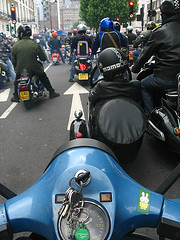
Last sunday was the Great London Rideout, 2008 - the largest classic scooter event in London. It's an annual run from Regent's Park to Southend, and each year something like 500 Italian Shopping Bikes take part, as well as a few autos and even a couple of classic bikes - this year there was an Enfield and a Moto Guzzi.


In the early days of the rideout, there would always be a solitary police car parked at the start (which back in 2000 was the Serpentine in Hyde Park), presumably to stop anyone flinging deck chairs at passing rockers. These days, the police stop the traffic so we can jump red lights at some parts of the route and stay together as a pack. The sight and sound of all these scooters moving in a vast peloton down Regent Street is something to see. Car drivers don't seem to mind much, and pedestrians love it - waving from the pavements and hanging out of windows.

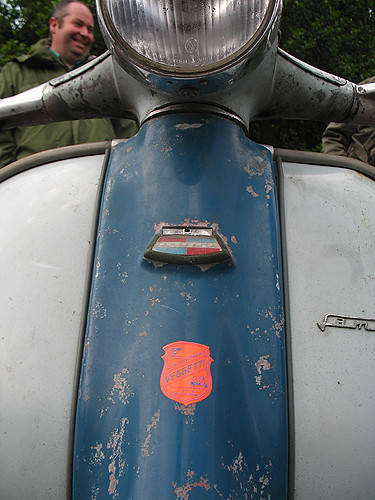
I rode my 1981 P125X, "DINO" as The Beloved Sprint "Bella" had failed her MOT. There are scooters of all ages and conditions - from the no-expense-spared restorations costing perhaps ten grand, to unrestored examples like this Lambretta Series 2, complete with its original paint and day-glo dealer sticker.

London

Last year, I rode "Bella" all the way to Southend with my mate on his PX. It was the first time we'd done it. This year we dropped out at Leytonstone for a bacon sarnie at home.

Tuesday, June 3, 2008

Frappe à la porte

France

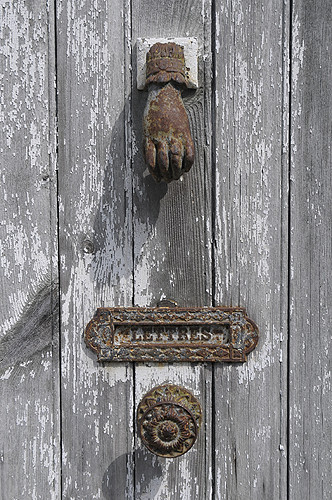
These hand-and-ball iron doorknockers are ubiquitous in France. They're common in Spain, too where the design is more lifelike. This rusty beauty was on a riverside house in Saint Savinien. The property had seen better days but was still lived in. I wonder if the owner shares my belief that decay can often be more beautiful than polished, painted perfection?

Monday, June 2, 2008

Magasin Fermé

France

During our week in the solidly rural Charente-Maritime region of France, I was struck by just how many villages and small towns had boarded-up shops and bars. Not closed for winter, but closed for good. The death of the small, independent business isn't just a British problem. Carrefour and Intermarché had several shiny new megastores in the immediate area, which must be especially hard for the small boucherie et charcuterie - these shops were by far the most common derelict premises.

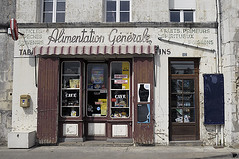
This alimenation générale seemed to be thriving, however. It's in the lovely small town of Saint Savinien, with the river Charente the other side of the street. What is it that is so appealing about signage painted directly onto a wall?

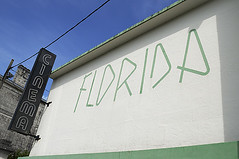
Saint Savinien also had this smart and clearly much-loved little cinema further along the river. Le Florida really does look like it's been transplanted from the art deco stretch of the Miami seafront.

France