Showing posts with label travel. Show all posts

Tuesday, April 19, 2011

Those We Have Loved

I'm a photographer who loves beer, so I've often got my camera with me in the pub. I've had nothing much to blog about just recently, so I hope you don't mind me sharing some images of beer that i've enjoyed over the last year or so. Apologies if some of the captions read like an optician's wall chart - It's times like this when I wish i'd chosen Wordpress over Blogger.

Bush Inn, Morwenstow

The Lamb, Bloomsbury

San Sebastian, Spain

Bad Toelz, Bavaria

Georgbrauhaus, Berlin

Elizabethan Bar, Westward Ho

The Narrowboat, Skipton

The Square and Compass, Worth Matravers

The Ship Inn, Lyme Regis

The Beaver, Appledore

Blue Bell, York

Seehaus Biergarten, Munich

Landsberg Am Lech, Bavaria

Starnberg, Bavaria

Tuesday, November 2, 2010

Ghentrification


Just back from a short trip to Ghent. Castles, trapgevel, bicycles, chocolate, bells, canals, frites, stoverij, beer. Nice town - unlike Brussels, which seems to get filthier with every visit. We weren't in Ghent long enough to really investigate the pubs, though we did have a couple of hours in the excellent Dulle Griet, squinting at the beer menu through the tobacco fug.


Another stop was the astounding Hopduvel, a ten minute walk outside the old city on the left bank of the Coupure canal. There are something like 1,200 different beers brewed in Belgium - and most of them are available in this barn of an off-licence. This selection is all I could physically carry - a curse of being a photographer is that my camera gear takes up space of at least six bottles.


Hiding at the back there is the most expensive beer I've ever bought - a Westvleteren 12, probably the most hyped brew of recent times. I'm sure you know the story - tiny batches, no labels, hard to find, yadda yadda. The beer is only officially available from the St Sixtus monastery, with its slightly bonkers reservation system. If you buy it anywhere else, it's a sort of 'grey export'.

WV12 is considered by some (not least Ratebeer) as the best beer in the world. How much of this opinion is formed by the exclusivity of it is hard to tell - but i've been looking for a bottle to try for two or three years. I picked this up at De Bier Tempel - researched by Mrs TIW as our best bet - in central Brussels along with a Westvleteren Blond and Westvleteren 8, the only three beers the monks brew commercially. I have no idea when i'll try it - i'm almost scared of it.

On our walk back to Midi station we were shadowed by the world's most obvious bag snatcher, culminating in a staring match before we got to the sanctuary of the Eurostar terminal. This is the third or fourth time we've been to the Belgian capital, and if anything Midi station is getting worse - reminding us of the stygian terminals we encountered on our rail journeys in China a few years back. Midi is certainly incomparable to the high Victorian glory of St Pancras that welcomes you back to London. Sort it out, Mr Van Rompuy.

Friday, August 13, 2010

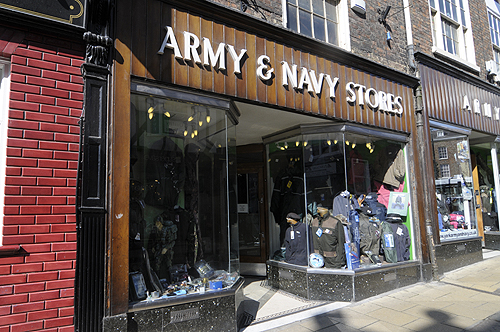
Mr and Mrs Storey's store

Yorkshire

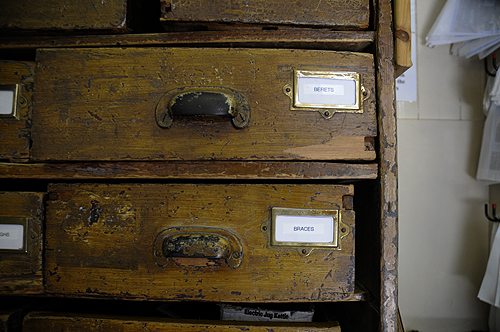
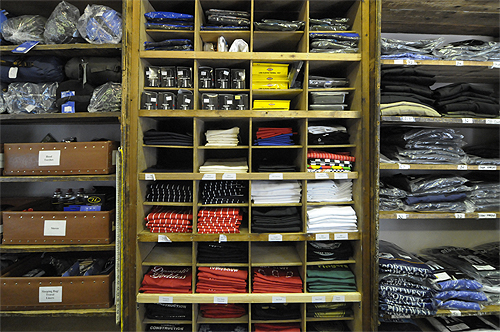
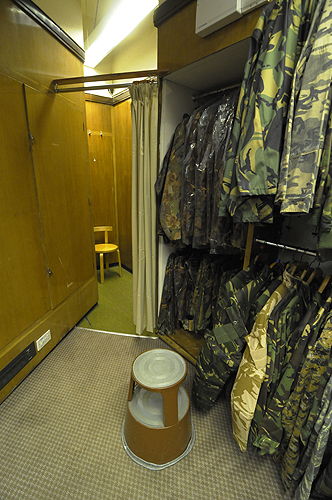
"My grandfather opened this shop. It's still doing OK. We're retired now, but we come in to keep an eye on things. When we took over from my dad there wasn't even any lighting on the top floor. Those are the original windows up there. We could have modernised and gone self service, but our customers like things the way they are. We don't owe anyone anything. We don't even have credit cards. Do you remember Russ Abbott? The Blue Bell is next door. A lot of his characters were based on the pub regulars. He was very kind to Mrs Pinder in her last days."

Yorkshire

Yorkshire

Yorkshire

Yorkshire

Yorkshire

Yorkshire

Thursday, August 12, 2010

Blue Bell? Would.


I'll try to get to the end of this post without using the tired old pub reviewers word 'gem'. But I'll struggle.

I first heard about the Blue Bell about three years ago, after my mum and dad found the place on one of their visits to York. IN PUB U'D RLLY LUV - came the text from my 70-year-old-dad, whose messages are apparently ghostwritten by a Walthamstow yoot - BLUE BELL INNIT.

Our visit last saturday afternoon was almost thwarted by a handwritten 'private party' sign on the front door. A bloke with a cig cupped in his palm sidled up and theatrically whispered "Go on in. Yer all right. That's to keep idiots out". So, officially recognised as not being idiots, in we went - back to 1903, the year the the pub was last given a makeover. Much has been written about the BB's untouched Edwardian interior, which has survived thanks largely to an ain't-broke-don't-fix-it approach from the family who ran the pub for decades. The last family licensee, Edith Pinder (by all accounts a redoubtable character - "she used to sit here like Mrs Haversham"), retired in 1992. Doubtless it was present owners Pubmaster who stuck the godawful sign above the marvellous tiled exterior.


Everyone remarks about the size of the Blue Bell, which has a street frontage of exactly 13 feet wide. It may be small for York, but it's not a lot smaller than the Mitre in London, and it's almost cavernous compared with the pocket-sized Boltmakers in Keighley. There are two rooms, front and back, split by the bar and connected by a dark, narrow corridor with its own serving hatch, presumably once there for off-sales. There are six hand pumps and a rack of continental bottles - La Chouffe and St Bernadus among them. We settled for an excellent Roosters Leghorn and a perfect Camfell Flame, which was a new one to us. The other beers were reliables like Deuchars, Landlord and the ubiquitous Black Sheep. I suspect this is more to do with Pubmaster than the tenants, who have an obvious enthusiasm for beer - the Blue Bell hosts one of the country's smallest ale festivals. The landlady reportedly knows the names of over 200 of her regulars, who were a mix of young and old and all backgrounds and classes. We were drawn into conversations that involved the whole room, and its possibly a good thing that we we only had time for a couple of pints, otherwise we'd still be in there now. The Blue Bell is one of those things that leaves your soul singing to know it exists, like Bolton Strid or the Merlin Engine or the Polar Bear or the Brooklyn Bridge. It's a much loved, much-used boozer, welcoming to everyone. Except idiots. An almost perfect pub, then, and oh, alright - a gem.

Monday, November 23, 2009

Cofio'r hogiau


On our trip to the Somme battlefields in July, the place with the most atmosphere by far was Mametz Wood. The site where the 38th (Welsh) Division was cut to ribbons between the 7th and 12th of July 1916 is marked by a statue of a belligerent red dragon, gripping barbed wire in its claw. The Welshmen advanced past this point towards the wood. In the hours before the assault they had been in their starting positions behind the ridge here, singing hymns they would have known from chapel and sunday school. Even by the standards of the Somme, taking Mametz was a hideous task - The 14th Welsh (Swansea) Battalion alone suffered almost 400 killed or wounded from some 680 men. Any who survived the open ground in front of the wood, swept by machine gun and tangled in the wire, faced a stubborn enemy dug into a natural fortress of fallen trees and thick undergrowth. Fighting in the wood was primitive and desperate - bayonet, grenade and rifle butt. A few days after the Germans had been forced out, the poet Robert Graves entered the wood to find a greatcoat for the unseasonably cold nights. He found the wood full of the dead of the South Wales Borderers and Royal Welch Fusiliers, looking pitifully small alongside the corpses of the big Prussian Guards.


Comparing maps from 1916 with the site today, Mametz has more or less the same 'footprint', though all the trees are post 1918. The wood is a brooding presence, glowering at you across the valley. I'm not the first visitor to feel like I was being watched by many unseen eyes. It was almost as if the wood gave out some sort or radiation - like being at the other end the room from a large fire. We considered walking up to the fringe of the trees, but both admitted later that we were relieved when the sudden sound of a hunter's shotgun from within the green dark made us return to the car.

Wednesday, September 2, 2009

Warning: Scooterbore

Owning a geared Vespa is like a secret handshake. A club without rules where every owner is a member. Wherever you are, Vespa owners always want to talk about their scooters - waiting at the lights, in the pub, in A&E. Doesn't matter. The copy of Scootering you read on the train might get you an upgrade to first class if the guard owns a GS, as happened to my mate.

Germany
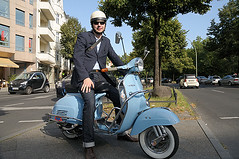
This bloke dribbled to a halt right in front of us as we were waiting to cross a street off Berlin's Kurfürstendamm. In my Tarzan German I asked him if he wanted any help, though it turned out he just needed to switch his fuel tap to reserve. He'd just picked up the scoot - a spotless and immaculate Rally - from the restorers, and was clearly as pleased as Punch with it.

Spain

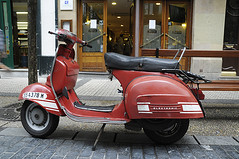
This example is also a Rally. I think it is, anyway. It's a licence-built Spanish MotoVespa with a Rally body but has the trapezoid headset found on early Sprints. MotoVespa scooters are something of a mystery to me. They often seem to have been built with whatever was in the parts bin at the time.

The scoot was parked photogenically outside a cafe in downtown San Sebastian. The owner was inside sipping a coffee, and when he saw me sneaking around with my camera immediately rushed out and moved his bags so I'd get a better shot. His face lit up when I showed him a photo of 'Bella', my beloved Sprint Veloce. His Rally (if that is indeed what it is ) was thirty years old, and he'd owned it from new. Then he plonked his old plastic helmet on my head and told me to have a ride while he finished el desayuno. So I did, and I didn't stop grinning until teatime.

Thursday, August 27, 2009

Southern Beer

I "went" 40 somewhere between Berlin and Halle on our nachtzug to Munich. Long-distance train travel in Germany is always enjoyable - especially if you treat yourselves to a sleeper carriage (cheaper than a hotel plus flight) with its own shower and WC. Even the bunks were good - the most comfortable beds of the entire trip. So comfortable, in fact, that I was out like a light before I'd even cracked open any of the bottles I'd picked up in Berlin.

We spent my birthday in Munich with our chum Dan at the Chinese Tower beergarden in the Englischer Garten. This is one of the largest city parks in Europe with acres of trees, grass, compulsory naked sunbathers, river surfers and two beergardens. Of these, HofBrau's Chinese Tower is by far the most popular, with its oompah band and cycle tours, and none the worse for that. The other is the much quieter Seehaus, run by Paulaner which has a decidedly 'yuppie' reputation amongst Müncheners.

Germany

When I lived in Munich a litre of beer was the equivalent of three or four quid depending on where and what you drank. Ten years and a recession later the price of a litre mass of helles at the Turm is over six pounds, but the ever-resourceful Dan had a stack of vouchers he'd clipped from a local newspaper, which took the edge off a bit. I also noticed that the always-grumpy blokes pouring the beer were giving full measures rather than the usual half inch below what we always call the 'magic mark', so presumably the credit-crunched locals had finally complained about short litres. HB is such an easy, enjoyable drink that an afternoon in the garten can get a bit expensive - but who cares? It's worth it. We ended up at old favourite Lucullus (Birkenau 31), scoffing lamb cutlets and souvlaki until well into the night - though memories of that part of the day are admittedly hazy.

Next day we knocked the corners off my hangover with a visit to the Augustiner Biergarten on Arnulfstrasse, up past the main station. This is without doubt one of my favourite places to drink, anywhere. I'd probably love it even if they only sold John Smith Smooth, rather than the sublime Augustiner Edelstoff. It's a big, shady spot, with seating for about 5,000 people, but never feels overcrowded even when full to bursting. After a few mass I've often found myself wondering if they'd allow me to have my ashes scattered here.

Many Muencheners consider Augustiner to be the city's best beer. Can't say I can disagree with them. Augustiner places are often a class above those of their competitors, and sometimes downright quirky. If you're in the city, try and find the side door of the Bratwurst Glöckl am Dom, near the Frauenkirche. It'll probably be closed, but push it open. You'll find a tiny, boisterous room at the bottom of a set of stairs rammed with tipsy locals. There's a serving hatch where a character from a Louis Buñuel film will hand you a foaming Edelstoff poured straight from the barrel. Don't enter if you've got a plane to catch, and whatever you do , no matter how much the other drinkers prompt you - and they will - don't ring the bell above the hatch.

Wednesday, August 26, 2009

Ich Bin Berliner

Germany

After the sweaty streets of Madrid, Berlin felt positively arctic at "only" 28 degrees. It was good to be in beer country once again, and one of our first stops was the Georgen Brauhaus on the banks of the Spree near Alexanderplatz. This is a relative newcomer, only brewing since 1992. Their beers get something of a hammering in some bits of the blogoshire, but I like their helles. I'd enjoyed it at a couple of UK beer festivals and was keen to try it from the fountainhead, so to speak. Here it was lemony, zesty and refreshing. Just the ticket after all that Cruzcampo, Mahou and Estrella Damm.

We hadn't planned it, but we were in town at the same time as the International Berliner Bierfestival, which claims to be the "longest beer garden worldwide" stretching as it does almost the entire length of Karl Marx Allee. We got there on our last day in Berlin, but couldn't indulge too much. I am without doubt the clumsiest man alive even when I haven't been on the pop, and I didn't fancy drunkenly riding my hire bike under a tram. I slaked the thirst acquired cycling from Friedichstrasse with a (very decent) Lübzer Pils and picked up a few bottles of other beers for later. As miracles happen on holiday I thought there might be a chance that one of the bottle shops could have a Westvleteren under the counter, but no. As it happens, there wasn't that much out of the ordinary to try, but it's worth a visit and would make a quieter alternative to the overrated Oktoberfest down south. The endless row of beer stalls was broken up with music stages. At each one a tiny audience was watching a be-mulleted and enthusiastic guitarist. Bless the Germans - no matter how hard they rock, they always end up looking a bit camp.

The Brits were represented by Greene King, Newcastle Brown and er, Strongbow. I suspect these were stalls run by local agents rather than an expeditionary force by the parent companies. But still - must try harder. Vietnam had a bigger presence than the UK.

Tuesday, August 25, 2009

Jamon Jamon

I've always been quick on the uptake. It only took me 48 hours to realise that the ladies "shopping" in the streets around Madrid's Callao metro station weren't following some local fad for dressing like hookers. They actually were hookers.

Spain

The city was suffocatingly hot - upper 90s during the day, and seemed even hotter at night. We were staying in a hostal off Calle Luna, a pretty dodgy area undergoing a transition similar to that which has happened to Spitalfields and Shoreditch in London. Grubby, seedy and interesting with poky little shops, sweaty bars, Chinese restaurants and a population of prostitutes, hustlers, young hipsters and one or two older residents wondering why the bakery has become a tattooists.

After San Sebastian and Santiago, eating out in Madrid seemed incredibly cheap. Casa Mingo (Paseo de la Florida 34) is a long established no-frills barn of a place which serves nothing much more than roast chicken, which tasted like chicken did before the supermarkets started to pile it high and sell it cheap. They also have their own Asturian sidra, which was just the right side of sweet and filled my entire head with a huge hit of fresh apple.

At Casa Granada, (Calle Del Doctor Cortezo 17) you have to press a buzzer at street level and either brave the tiny lifts or walk to the top floor of a dingy office block off Plaza de Tirso de Molina‎. Worth it though, for the view of the city from the terrace, and to be brought tapas by a friendly Mexican with lurid special forces tattoos.

Spain

Museo Del Jamon are a chain which seem to share the original philosophy of Harry Ramsden's before it was bought out and became rubbish - that nothing is too good for ordinary folk. Scoffing the Spanish equivalent of ham, egg and chips washed down with a Mahou in a noisy, panelled room lit by chandeliers the bill only came to about 8 quid. If any verification of the Museo's scran were needed, the queue which stretched down the stairs into the standing-only deli/cafe below contained a group of elderly priests and a young, scowling nun. There's a joke here somewhere.

Sunday, August 23, 2009

Sultans Of Swing

Leaving the Sabastianos to their gilded lives, we set off to Santiago De Compostela - by train. There's one RENFE service a day and it takes 12 hours. I devoured two books, listened to most of my ipod and had four different passengers sat next to me, only one of whom was sick all over themself. We passed through a landscape that went from lush, to parched - ooh look, an Osborne Bull - and eventually to green hills and swooping gorges spanned by elegant road bridges. Galicia.

Spain

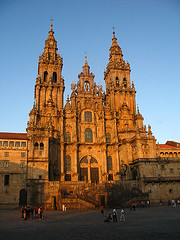
In Santiago we hooked up with with Mrs TIW and our Spanish chum G who had both just completed a portion of the Camino Di Santiago - the pilgrimage sometimes described as the Catholic Hajj. Santiago's glory is the Cathedral Of St James - which, basking in the golden light of that evening resembled nothing less than Angkor Wat

Spain

Over the next couple of days I attended the Camino mass twice, a moving experience even for a heathen like me. The Camino reaches its peak in summer, and the cathedral was crammed with pilgrims, many with muddy shoes, still wearing rucksacks and often in tears. The scallop shell - symbol of St James - was everywhere, hanging from walking sticks and bags and hats. Some of the people here had trekked or cycled from as far away as Sweden. One lad we met had taken three months to trudge from Southern Germany, eating nothing but boiled potatoes. The emotion in the air was almost tangible, particularly when the priests read out the towns that the walkers had started from.

Spain

The climax - if that's the word - of the ceremony is the swinging of the Botafumeiro, the cathderal's gigantic incese burner, the largest of its type in Europe. It takes eight red-robed men pulling on ropes to move it on its 70 metre arc, dangling from a surprisingly frail-looking pulley system. It swishes above the congregation with such force that it almost - but not quite - touches the nave ceilings either side of the Shrine Of St James, filling the entire cathedral with holy smoke. Our spud-eating Bavarian claimed that the original purpose of this was to mask the smell of the pilgrims in the days before showers and deodorant. Not surprisingly, accidents have happened - most notably when Catherine Of Aragon stopped off in Santiago on the way to marrying our own Henry VIII. On that occasion the rope failed and the burner flew out of a high window.

Wednesday, August 19, 2009

Pintxo Point


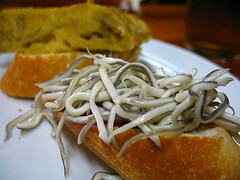
San Sebastian is one of those places that has you gazing longingly into the windows of estate agents within hours of arriving. It's such a beguiling mixture of climate, beauty, people and food. Blimey, the food. There's such a load of cobblers written about San Sebastian - despite what the sunday broadsheets say, every bar does not deserve a Michelin Star - but the overall standard of nosh is exceptionally high. I'm not going to pretend to be an expert on tapas - or pintxos, as the Basques call them. I couldn't even tell you what most of them were called, but drifting from bar to bar in the Old Town scoffing whatever is on offer, is one of life's finest things. It's not cheap, but then it shouldn't be either - apart from the ever-present jamon, the pintxos are mainly seafood with an emphasis on cod, sardine, anchovy and tuna. The fruits of the sea are a matter of fierce pride for the famously outward-looking and seafaring Basques. EU quotas seemed to have decimated the number of fishing vessels in the harbour since our last visit, but it still buzzed with maritime activity and is still a focal point for the locals. Cod and tuna in particular are becoming a rarer and much more difficult and dangerous catch. To paraphrase Walter Scott, it's wasn't fish we we're eating, it was men's lives, so we made sure we finished every morsel, as we would in Whitby or Newlyn. Every bar we visited was pretty good, but the real standouts were the tiny Bar Tamboril (warning: annoying, overdesigned website) on Calle Pescaderia, Bar Aralar at 10 Calle Puerto which was so boistrous and friendly that we kept returning, and the place next door where I had anguillas, a pinxto of tiny eels so spectacularly gorgeous I'm still thinking about it.
Spain

Funny how beer you'd tip down your sink at home tastes just brilliant when you're on holiday - even something from Cruzcampo called (I think) 'Polar', a sort of Iberian Fosters Ice. Cruzcampo, along with their owners Heineken rule the roost here, with Amstel and the ubiquitous Mahou. Personally, I've always found Mahou a pretty decent drink home or away, but it was good to find the odd bar with a Pilsner Urquell tap.

Along with Asturias and Galicia, the Basque Country is one of Spain's cider regions. We'd missed the season for visiting San Sebastian's out-of-town cider houses, but we tracked some sidra down at anchovy-specialist Bar Txepetxa (picture in the post below) at 5 Calle Pescaderia. As in Asturias, It was poured from shoulder level by the barman to 'aereate' the liquid. I'm not sure this bit of theatre has any effect on the taste, but I'm not complaining. It was astringent, sour and made you want to suck your cheeks inside out - and utterly delicious. The perfect palate cleanser for more pintxos and more cerveza and more tinto.


We ended up spending a day longer than we planned in San Seb. The doughnut at the hire car agency in Lille forgot to give Our Lad his licence back, so the next leg of our journey was spent not in a Parador near Gijon, but rattling across country in a RENFE train that stopped at every lamppost and farm. Should you find yourself in a similar predicament, be assured that an extra 24 hours in this lovely city is definately no hardship.